How Qimen divination works
The guided flow — from question to Nine Palaces interpretation.
Updated 2026-04-15
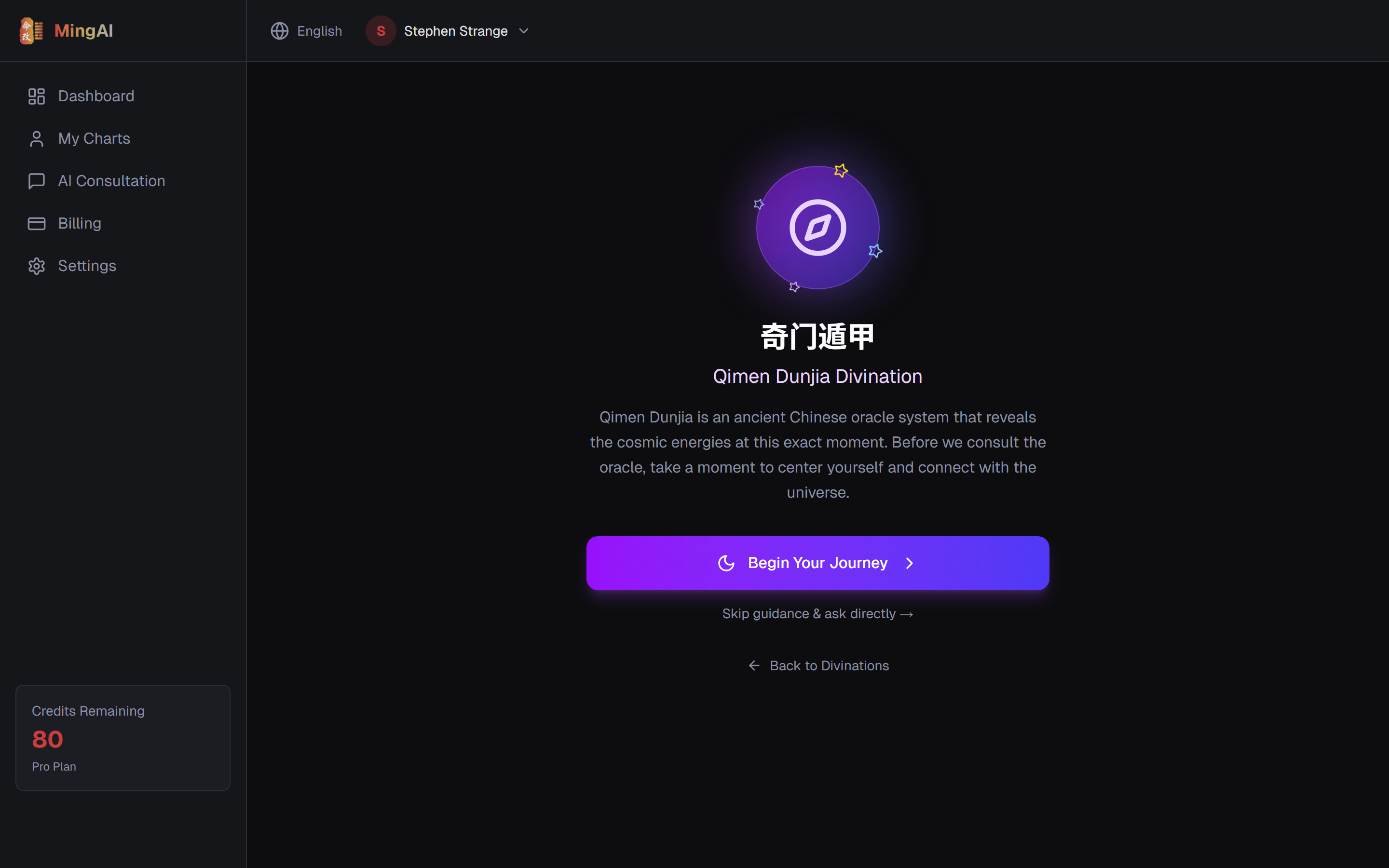

Qimen Dunjia (奇门遁甲) is a classical Chinese divination system. MingAI wraps it in a guided flow designed to slow you down, help you focus, and give you an honest reading.
The flow
- Welcome screen — an animated compass sets the tone.
- Breathing exercise — two cycles of 4 seconds in, 4 hold, 4 out. This isn't fluff — Qimen readings depend on the moment you ask. Slowing down keeps that moment meaningful.
- Focus meditation — four prompts to clarify what you actually want to know.
- Question input — write your question in one or two sentences. Pick a category: career, relationship, business, travel, timing, or general.
- Reveal — the chart generates in real time, using your current location (for True Solar Time) and the exact moment of the question.
Reading the chart
The Nine Palaces grid places:
- Eight Gates (八门) — situational forces around the central palace.
- Nine Stars (九星) — quality of influences from above.
- Eight Spirits (八神) — intentions behind the influences.
- Heavenly Stems — the 甲-癸 positions that drive the reading.
MingAI's AI interpretation walks through the Useful God palace, the matching palace for your question category, and any notable clashes or pattern combinations.
Cost
The Qimen Dunjia add-on is $88.8/mo (Bazi Pro required). Once subscribed, chart casting is unlimited and free — cast as many charts as the question deserves. The only metered part is the AI conversation that reads your chart: 1 Bazi credit per AI message, drawn from the same credit pool as your Bazi chats. See Qimen plan and credits.
Best practices
- One clear question per session. "Should I take Job A or stay at Job B?" works. "Everything about my career" doesn't.
- Don't re-ask immediately. If you don't like the answer, waiting and re-asking the same question the next day is considered bad form and often yields worse readings.
- Trust the moment. The chart reflects the energetic state of when you asked — not when your question resolves.
Still need help?
Contact us